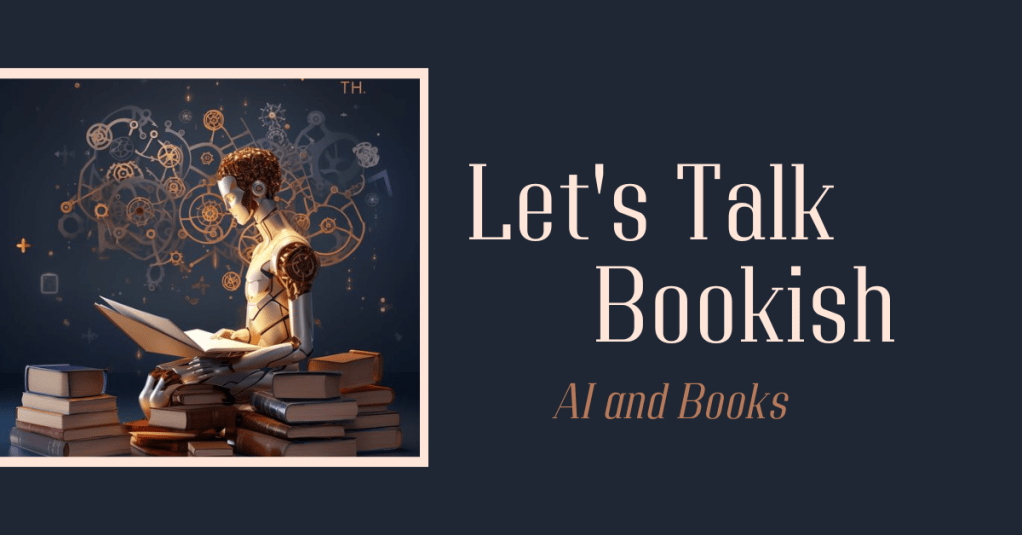
Let’s Talk Bookish is a weekly meme originally created and hosted by Rukky @ Eternity Books starting in August 2019, and was then cohosted by Dani @ Literary Lion from May 2020 to March 2022. Since April 2022, the meme moved to another host, Aria @ Book Nook Bits.
Let’s Talk Bookish is a meme where participants discuss specific topics, share their opinions, and share their love by visiting each other’s posts.
Hello! so, here the new topic!
The topic is
AI and Books
Prompts
From books being used to train AI systems without author knowledge to AI-generated books on Amazon, the book world has been full of AI-related news. Have you heard about these situations? What do think about the use of AI when it comes to creative writing and books?
In a world where technology is advancing at an unprecedented rate, it comes as no surprise that artificial intelligence (AI) has made its mark in the realm of literature and books. From assisting in writing to generating entire works of fiction, AI has truly revolutionized the way we perceive and interact with books.
Unveiling the Unseen: AI Training on Books Without Author Knowledge
One of the most controversial revelations in recent times has been the use of books to train AI systems without the knowledge or consent of the authors. Imagine pouring your heart and soul into a literary masterpiece, only to have it dissected and analyzed by a machine without your permission. This ethical dilemma has sparked a heated debate within the literary community, raising questions about intellectual property rights and the boundaries of AI technology.
The Rise of AI-Generated Books on Amazon
On the flip side, the emergence of AI-generated books on platforms like Amazon has caught the attention of both readers and writers alike. These books, created entirely by artificial intelligence, blur the lines between human creativity and machine intelligence. While some argue that these AI-generated books lack the depth and emotion of human-authored works, others see them as a fascinating glimpse into the possibilities of AI in the literary world.
Embracing the Future: The Intersection of AI and Books
As we navigate this new chapter in the book world, it is essential to embrace the potential that AI brings to the table. AI can assist authors in generating ideas, refining writing styles, and even predicting reader preferences. By harnessing the power of AI, writers can unlock new levels of creativity and innovation, shaping the future of literature in ways we never thought possible.
What do think about the use of AI when it comes to creative writing and books?
In the age of technological advancements, artificial intelligence (AI) has made its way into various industries, including the world of creative writing and literature. The use of AI in generating content, aiding in the writing process, and even creating entire books has sparked both excitement and skepticism in the literary community. But what exactly does this mean for the future of creative writing and the world of books?
AI in Creative Writing
AI technology has the ability to analyze vast amounts of data, recognize patterns, and generate content based on algorithms and machine learning. This has led to the emergence of AI-powered writing tools that can assist writers in various ways, such as suggesting alternative words, providing grammar and style suggestions, and even helping with plot development.
One of the most famous examples of AI in creative writing is OpenAI’s GPT-3 (Generative Pre-trained Transformer 3), a language model that can generate human-like text based on a given prompt. Writers can use GPT-3 to generate ideas, brainstorm characters and settings, or even create entire stories.
The Pros and Cons
Pros
- Efficiency: AI can help writers save time by automating certain aspects of the writing process.
- Inspiration: AI can provide writers with new ideas and perspectives that they may not have considered on their own.
- Accessibility: AI-powered writing tools can make writing more accessible to a wider range of people, including those with disabilities.
Cons
- Authenticity: Some critics argue that AI-generated content lacks the human touch and authenticity that comes from genuine creativity.
- Ethical Concerns: There are concerns about plagiarism and copyright issues when using AI to generate content.
- Dependency: Writers may become overly reliant on AI tools, potentially stifling their own creative abilities.


 BOOKFLOWERPATH
Rispondi